
Atlas V 541
The Atlas V 541 was chosen to be the rocket to launch Curiosity because it has thr right requirements to put Curiosity into space. The rockets in the Atlas family are usually perfect for Mars missions. Atlas V rockets are ELVs or expendable launch vehicles, so they can only be used once. The major parts of the rocket consist of the payload fairing, solid rocket boosters, Stage one Atlas V booster, and the stage two centaur. The payload is made up of a aluminum-honeycomb structue and graphite expoxy sheets. It contains Curiosity covered in the cruise stage. There are four solid rocket boosters or SRBs that burn on for ninety-two seconds before jettisoning th the ocean. They are made of graphite expoxy that covers the outside of the booster. It measures sixty-one feet in diameter and sixty-seven in length. the SRBs are retrieved by boats later to prevent pollution in the ocean. the Atlas v booster stage is 12.5 feet in diameter and 106.5 feet in length. Its tanks are made of a rigid aluminum structure with intertank skirts. This booster stage is powered by the RD-180 engine system ( a engine with two thrust chambers ). the RD-180 burns up RP-1 ( Rocket Propellant-1 ) and liquid oxygen. RP-1 is highly purified kerosene, and when it is combined together with liquid oxygen, explosions are made to power the rocket. This booster stage will provide 860,000 pounds of thrust at sea level. It is controlled by the centaur avionics system, which is a computer that controls the rocket. the Stage twocentaur will navigate the flight through the athmosphere. It is covered by the bicector ( two-piece shell ) which is made up of a aluminum-honeycomb structure and is covered in graphite-expoxy face sheets.
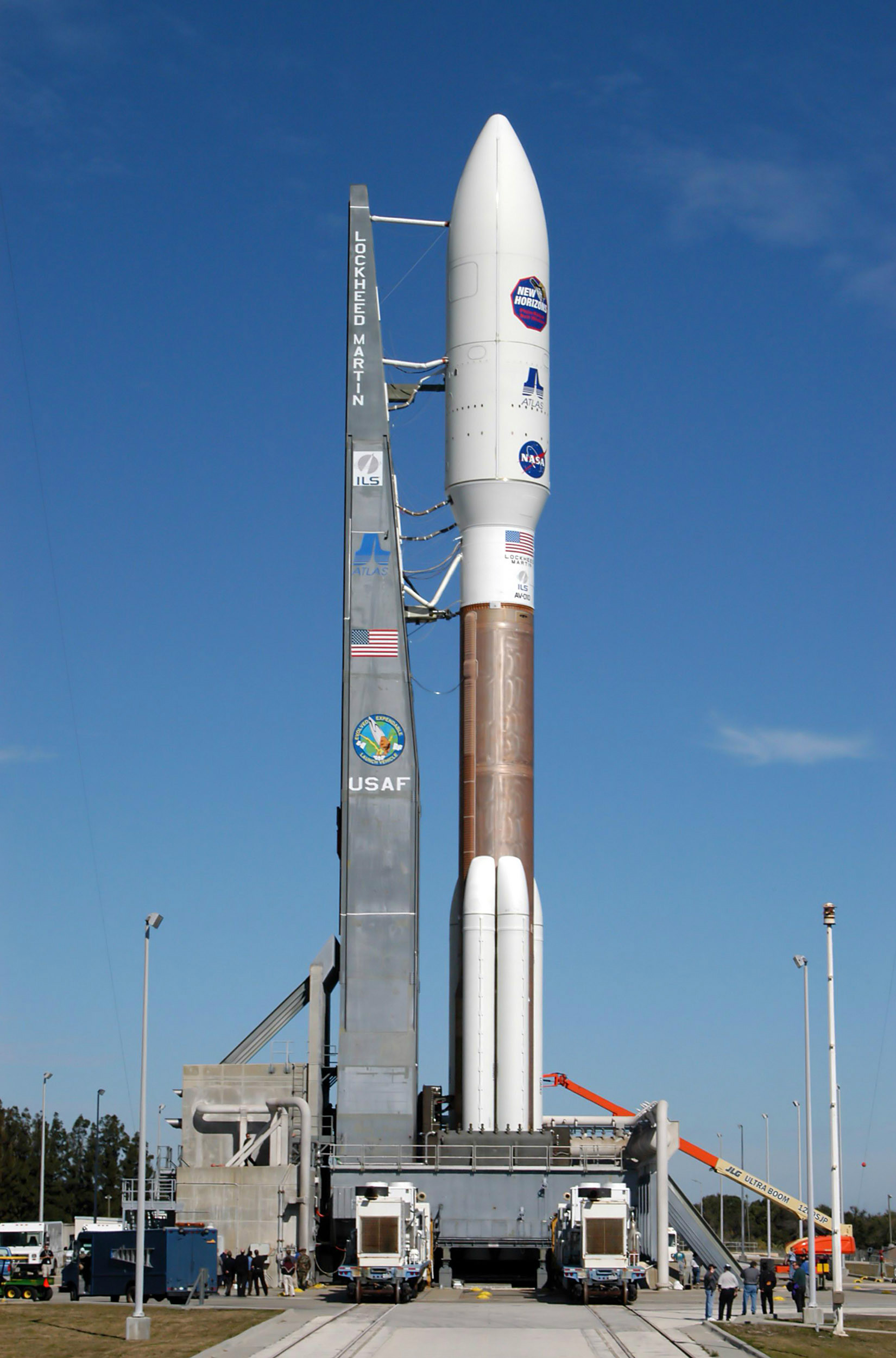
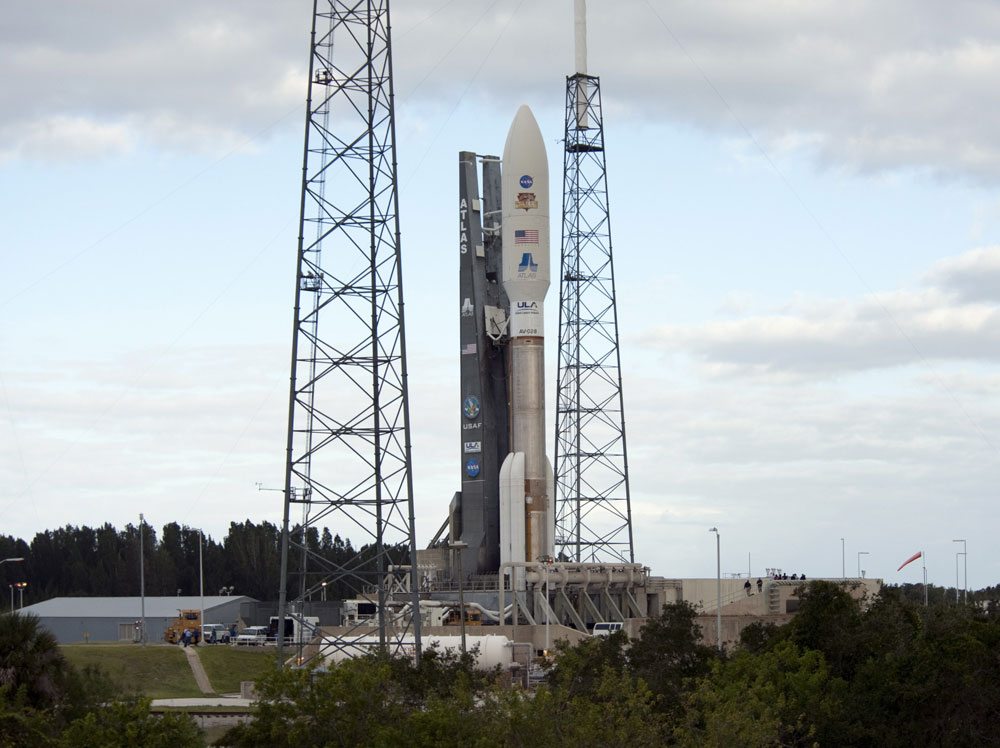
Pre-Launch Stages
T-720 minutes (12 hours until launch)
Check countdown clock for system failiures.
Countdown begins.
Everyone is cleared from the Mobile Launcher Platform (MLP).
Pad Environmental Control System (ECS) prepares for launching , including air-conditioning and nitrogen cooling.
Weather report.
Warning lights and alarms are activated.
Turn on searchlights if held at night or early morning.
T-510 minutes
Mobile Launcher Pad is transported to launch pad and secured.
Start Atlas system to turn on cryogenic tanks ( cooling ).
Parts are checked.
Atlas liquid oxygen (fuel) system preparations are complete.
Hazardous Gas Detection System is prepared.
Centaur liquid hydrogen (fuel) system preparations are complete.
T-120 minutes and holding (30 minute hold).
T-120 minutes and counting.
Start cooling stages on upper liquid oxygen tank.
Start cooling stages on Atlas V and Mobile Launcher Platform.
Start Atlas V helium bottle conversion to higher pressure.
Begin raising Atlas to higher pressure levels.
Atlas V RP-1 fuel storage compacts to higher pressure.
T-115 minutes and counting.
T-110 minutes and counting.
Start Atlas V liquid oxygen tube cooling.
T-103 minutes and counting.
Start LO2 fueling.
T-93 minutes and counting.
Cool liquid hydrogen tank.
T-90 minutes and counting.
Start fueling Atlas V with liquid oxygen.
T-85 minutes and counting.
Start liquid hydrogen pipe cooling.
T-60 minutes and counting.
Start Centaur engine cooling.
T-55 minutes and counting.
Prepare to raise hydraulic pressures.
T-45 minutes and counting.
Pressurize Main Engine Air System to higher pressure.
T-16 minutes and counting.
Start fuel filling steps.
T-10 minutes and counting.
Weather briefing.
T-5 minutes and counting.
Fuel filling steps are complete.
Water system (cooling) pressure adjustment is completed.
Atlas L02 is prepared for launch.
Atlas LH2 is prepared for launch.
T-4 minutes and holding (10 minute hold).
Spacecraft depends on own power (separation of power supply from launch pad).
T-4 minutes and counting.
Dangerous gas detection system is finished.
Automatic computer system takes control of all major events.
Atlas first stage LO2 tank is firmly attatched, allowing the tank to be pressurized for flight.
T-3 minutes and counting.
Atlas fuel tanks reach higher pressure.
T-2 minutes and counting.
L02 and LH2 tank connection will detatch in 10 seconds.
T-90 seconds and counting.
T-Zero
Liftoff of the Atlas V!